
AppComplianceLLM
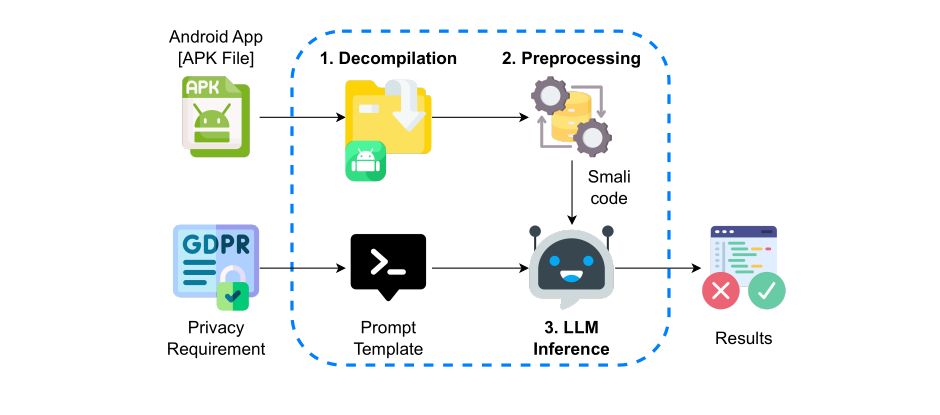
LLM-driven GDPR compliance checking for Android apps. It reads an app's Smali bytecode — no source code and no privacy policy needed — and, for a natural-language privacy requirement, asks an LLM per method whether that method implements the requirement, returning a binary YES/NO answer with an explanation.
How it works
Interactive demo
AppComplianceLLM checks whether an Android app satisfies a privacy requirement straight from its Smali bytecode — no source code, no privacy policy. It fills a zero-shot prompt with the requirement plus a method's Smali and asks the LLM for a binary YES/NO answer with an explanation. Here the requirement is R1 (GDPR Article 17, "Right to Erasure"): "The user shall be able to delete their account". Pick a method to see the LLM's verdict — including the real false positives.
Pick a task above to see it in action.
The first three LLM answers are reproduced from the paper's experiments on RegApp (the authors' demo app) and WordPress (10M+ downloads). The final case is a Simulated preview using representative fictional input, included to show how a lexical false positive can look; it is not a paper result. Nothing runs in the browser and no model is called. Run the artifact with apktool and Ollama / Llama-3.1 8B for real applications.
Paper
Cite this artifact
@inproceedings{10.1145/3696630.3728508,
  author    = {Alecci, Marco and Sannier, Nicolas and Ceci, Marcello and Abualhaija, Sallam and Samhi, Jordan and Bianculli, Domenico and Bissyand\'{e}, Tegawend\'{e} F. and Klein, Jacques},
  title     = {Toward LLM-Driven GDPR Compliance Checking for Android Apps},
  booktitle = {Companion Proceedings of the 33rd ACM International Conference on the Foundations of Software Engineering},
  series    = {FSE NIER '25},
  year      = {2025},
  pages     = {606--610},
  publisher = {Association for Computing Machinery},
  address   = {New York, NY, USA},
  doi       = {10.1145/3696630.3728508},
  url       = {https://doi.org/10.1145/3696630.3728508}
}