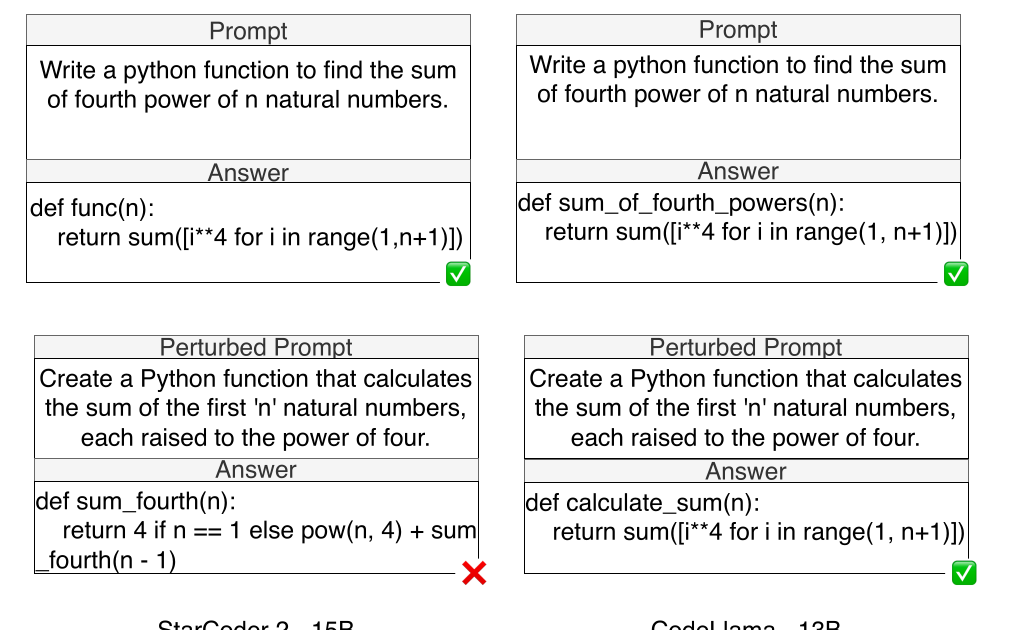
A framework quantifying the memorization advantage of code LLMs via the Perturbation Sensitivity Hypothesis — measuring how model performance degrades under small, meaning-preserving prompt perturbations.
Memorization advantage example, impact of prompt perturbation on the outputs of StarCoder and CodeLlama (paper, Figure 2)
Interactive demo
Choose a benchmark task to preview how CodeLLM-Memo can compare a model's response before and after a small, meaning-preserving perturbation. The mock pipeline highlights both fragile and stable behavior at a glance.
Pick a task above to see it in action.
Interactive simulation only — no model is called in the browser. Prompts, snippets, labels, and scores below are fictional but plausible examples of the framework's workflow; they are not measurements reported by the paper.
@inproceedings{djire2026quantifying,
  author    = {Djir\'{e}, Alb\'{e}rick Euraste and Kabor\'{e}, Abdoul Kader and Samhi, Jordan and Barr, Earl T. and Klein, Jacques and Bissyand\'{e}, Tegawend\'{e} F.},
  title     = {Quantifying Memorization Advantage in Code LLMs},
  booktitle = {Proceedings of the 48th IEEE/ACM International Conference on Software Engineering},
  year      = {2026},
  publisher = {Association for Computing Machinery},
  url       = {https://conf.researchr.org/details/icse-2026/icse-2026-research-track/37/Quantifying-Memorization-Advantage-in-Code-LLMs}
}