
CoDoC
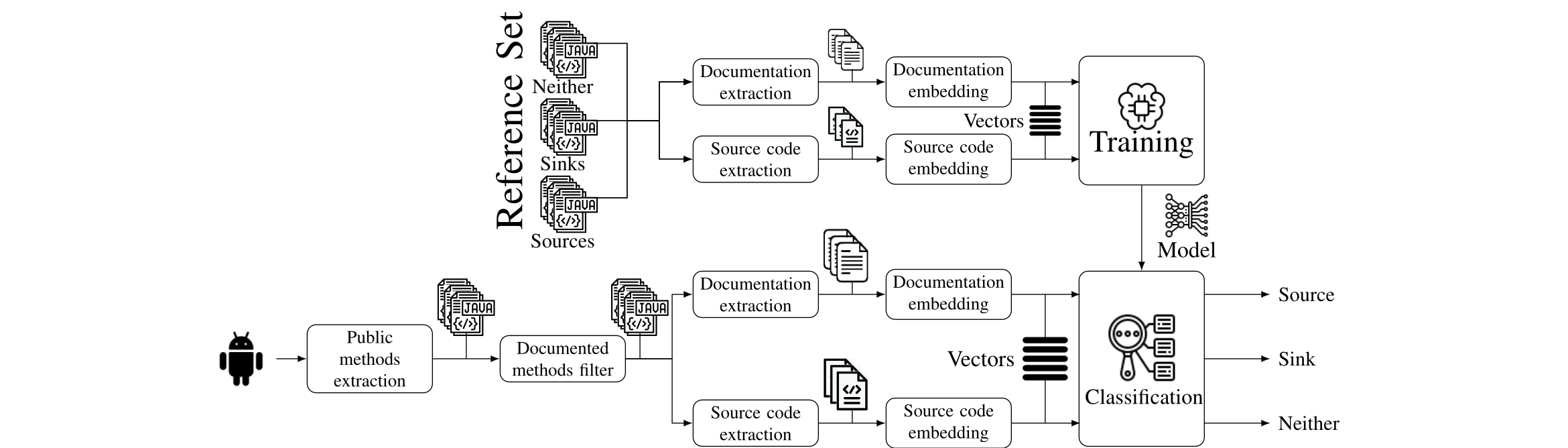
Identifies privacy-sensitive SOURCE and SINK methods in the Android framework by fusing two views of each method — its source code (embedded with Code2Vec) and its JavaDoc documentation (embedded with Sentence-BERT) — and classifying it as SOURCE, SINK, or NEITHER for taint-analysis lists.
How it works
Interactive demo
CoDoC decides whether an Android framework method is a privacy-sensitive SOURCE, a SINK, or NEITHER — by fusing two views of the method: its source code (embedded with Code2Vec) and its JavaDoc documentation (embedded with Sentence-BERT). Pick a method to see the classifier's verdict. The last two are false positives documented in the paper's negative-results analysis.
Pick a task above to see it in action.
A "negative results" study. In 10-fold cross-validation CoDoC reaches precision / recall / F1 = 91%, beating the state-of-the-art SuSi. But on unseen Android framework methods it over-flags and produces many false positives — machine learning struggles to pin down an abstract concept like "privacy" in practice. The cases are documented by the paper; source and JavaDoc snippets are shortened for display and no confidence score is invented. Nothing runs in your browser. Open-source prototype and artifacts are available on GitHub.
Paper
Cite this artifact
@inproceedings{10123678,
  author    = {Samhi, Jordan and Kober, Maria and Kabor\'{e}, Abdoul Kader and Arzt, Steven and Bissyand\'{e}, Tegawend\'{e} F. and Klein, Jacques},
  title     = {Negative Results of Fusing Code and Documentation for Learning to Accurately Identify Sensitive Source and Sink Methods: An Application to the Android Framework for Data Leak Detection},
  booktitle = {2023 IEEE International Conference on Software Analysis, Evolution and Reengineering (SANER)},
  year      = {2023},
  pages     = {783--794},
  publisher = {IEEE},
  doi       = {10.1109/SANER56733.2023.00091},
  url       = {https://doi.org/10.1109/SANER56733.2023.00091}
}