
DexRay
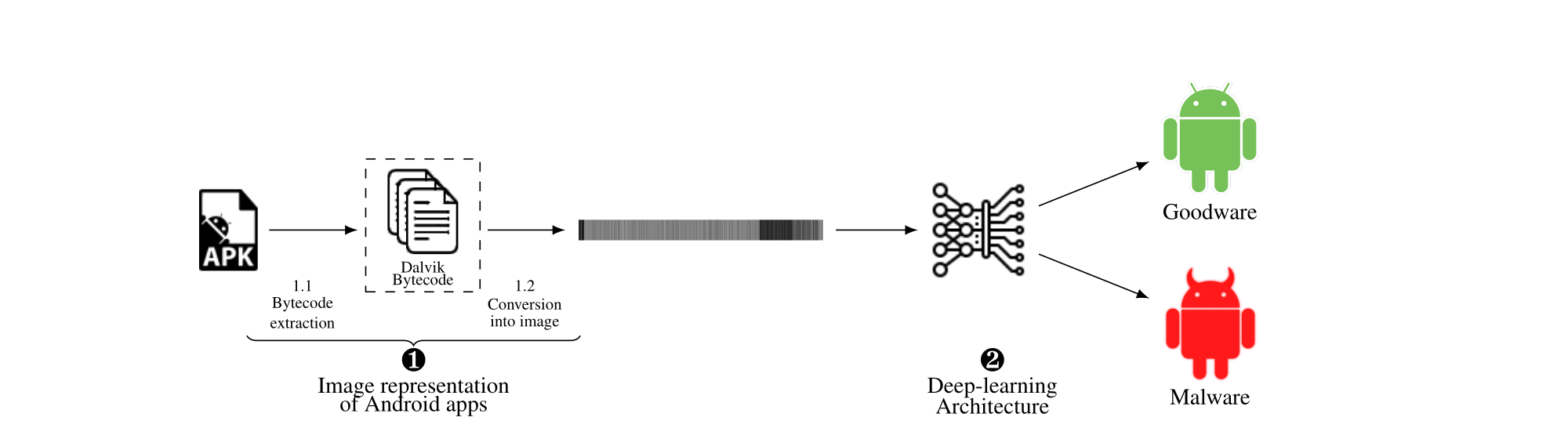
A simple yet effective image-based Android malware detector. It converts an app's DEX bytecode into a grey-scale "vector" image — one pixel per byte — and feeds it to a 1-dimensional CNN that predicts malware or goodware, with no hand-crafted features.
How it works
Interactive demo
Pick an APK profile. DexRay maps every DEX byte to one grey-scale pixel, resizes the resulting one-dimensional representation, and sends it through the CNN for a malware/goodware verdict.
Pick a task above to see it in action.
Simulated preview using procedurally generated images and representative fictional APKs; nothing runs in the browser and no model is called. The displayed textures, sigmoid scores and verdicts are illustrative UI output, not per-app results or measurements reported by the paper.
Paper
Cite this artifact
@inproceedings{daoudi2021dexray,
  author    = {Daoudi, Nadia and Samhi, Jordan and Kabor\'{e}, Abdoul Kader and Allix, Kevin and Bissyand\'{e}, Tegawend\'{e} F. and Klein, Jacques},
  title     = {DexRay: A Simple, yet Effective Deep Learning Approach to Android Malware Detection Based on Image Representation of Bytecode},
  booktitle = {Deployable Machine Learning for Security Defense (MLHat 2021)},
  series    = {Communications in Computer and Information Science},
  volume    = {1482},
  year      = {2021},
  pages     = {81--106},
  publisher = {Springer},
  doi       = {10.1007/978-3-030-87839-9_4},
  url       = {https://doi.org/10.1007/978-3-030-87839-9_4}
}