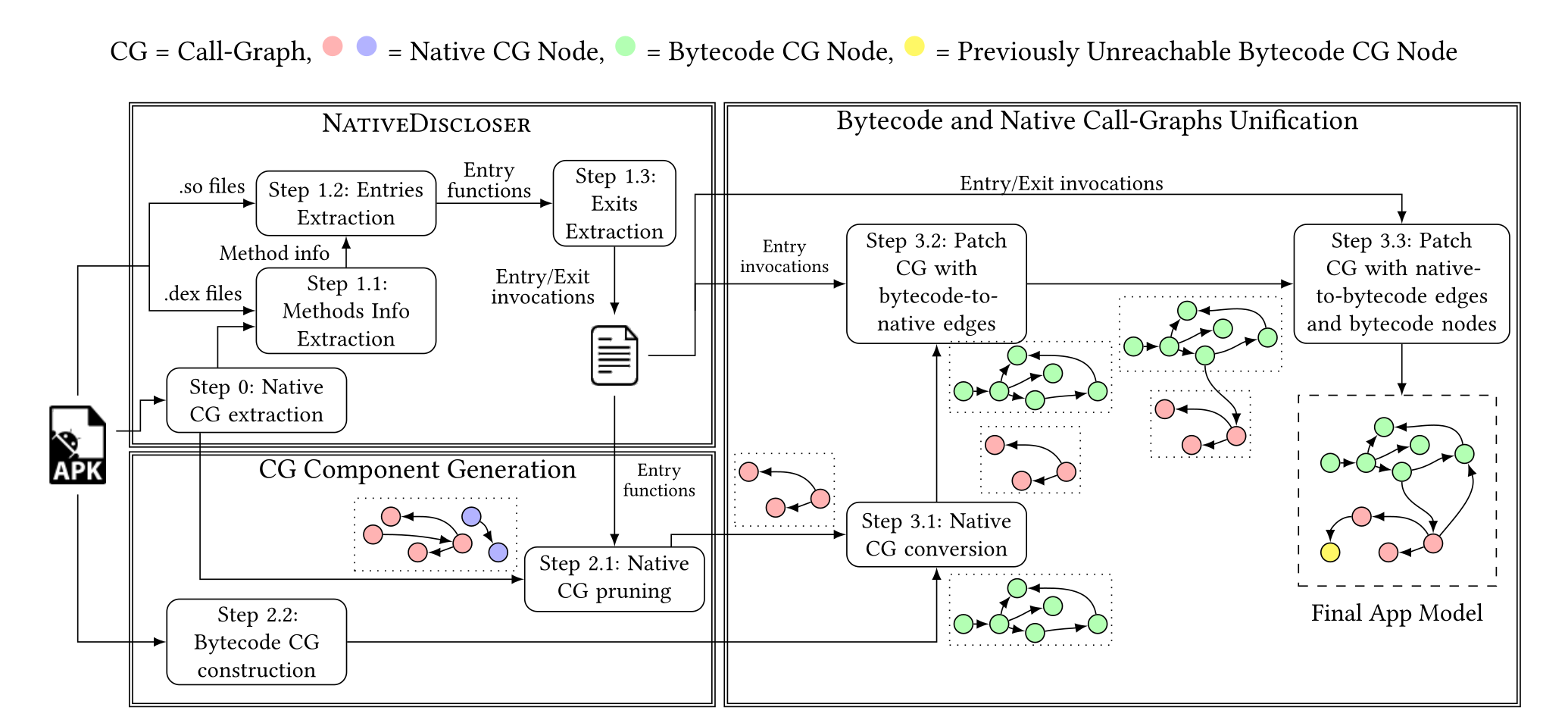
Unifies Android bytecode and native code into a single representation so static analyzers can see the whole app — revealing sensitive flows that cross the Java/native boundary.
Overview of the JuCify approach, from the angle of call-graph construction (ICSE 2022 paper, Figure 2)
Interactive demo
Pick a cross-language flow pattern. JuCify imports the native call graph, links JNI transitions to the Android bytecode representation, then lets the downstream taint analysis recover paths that cross Java and native code.
Pick a task above to see it in action.
Simulated preview using representative fictional APKs, JNI methods, graph counts and taint paths; nothing runs in the browser. The getter, leaker and delegation patterns mirror the cross-language scenario families discussed by the work, but the concrete outputs below are not paper results.
@inproceedings{10.1145/3510003.3512766,
  author    = {Samhi, Jordan and Gao, Jun and Daoudi, Nadia and Graux, Pierre and Hoyez, Henri and Sun, Xiaoyu and Allix, Kevin and Bissyand\'{e}, Tegawend\'{e} F. and Klein, Jacques},
  title     = {JuCify: A Step Towards Android Code Unification for Enhanced Static Analysis},
  booktitle = {Proceedings of the 44th International Conference on Software Engineering},
  year      = {2022},
  pages     = {1232--1244},
  publisher = {Association for Computing Machinery},
  address   = {New York, NY, USA},
  doi       = {10.1145/3510003.3512766},
  url       = {https://doi.org/10.1145/3510003.3512766}
}