
LuxemBERT
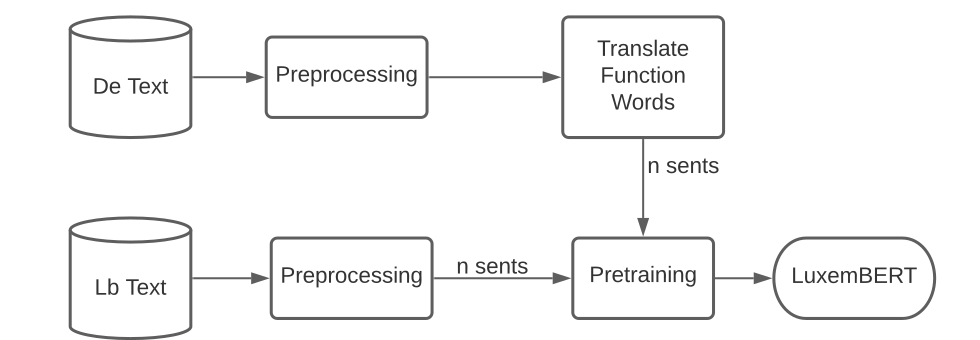
A BERT model for Luxembourgish — a low-resource West Germanic language — trained with a simple, practical data-augmentation trick: partially translate closely-related German text into "pseudo-Luxembourgish" by swapping unambiguous function words, then mix it with real Luxembourgish. LuxemBERT outperforms a Luxembourgish-only baseline and multilingual mBERT on most evaluated task variants; the paper reports five of six wins over mBERT, with the cased model winning all six. The study also creates four annotated downstream datasets, available from the authors on request.
How it works
Interactive demo
Try three Luxembourgish masked-language prompts and preview the top tokens a LuxemBERT fill-mask pipeline could return.
Pick a task above to see it in action.
Interactive simulation — prompts, token rankings, and probabilities are illustrative mock outputs chosen to demonstrate masked-language modeling. No model inference runs in the browser and these values are not paper measurements.
Explore the dataset
The uncased LuxemBERT model is on the Hugging Face Hub.
from transformers import AutoTokenizer, AutoModelForMaskedLM

tok = AutoTokenizer.from_pretrained("lothritz/LuxemBERT")
model = AutoModelForMaskedLM.from_pretrained("lothritz/LuxemBERT")
Paper
Cite this artifact
@inproceedings{lothritz-etal-2022-luxembert,
  author    = {Lothritz, Cedric and Lebichot, Bertrand and Allix, Kevin and Veiber, Lisa and Bissyand\'{e}, Tegawend\'{e} F. and Klein, Jacques and Boytsov, Andrey and Lefebvre, Cl\'{e}ment and Goujon, Anne},
  title     = {{LuxemBERT}: Simple and Practical Data Augmentation in Language Model Pre-Training for Luxembourgish},
  booktitle = {Proceedings of the 13th Language Resources and Evaluation Conference (LREC)},
  year      = {2022},
  pages     = {5080--5089},
  publisher = {European Language Resources Association},
  url       = {https://aclanthology.org/2022.lrec-1.543/}
}