
MalLoc
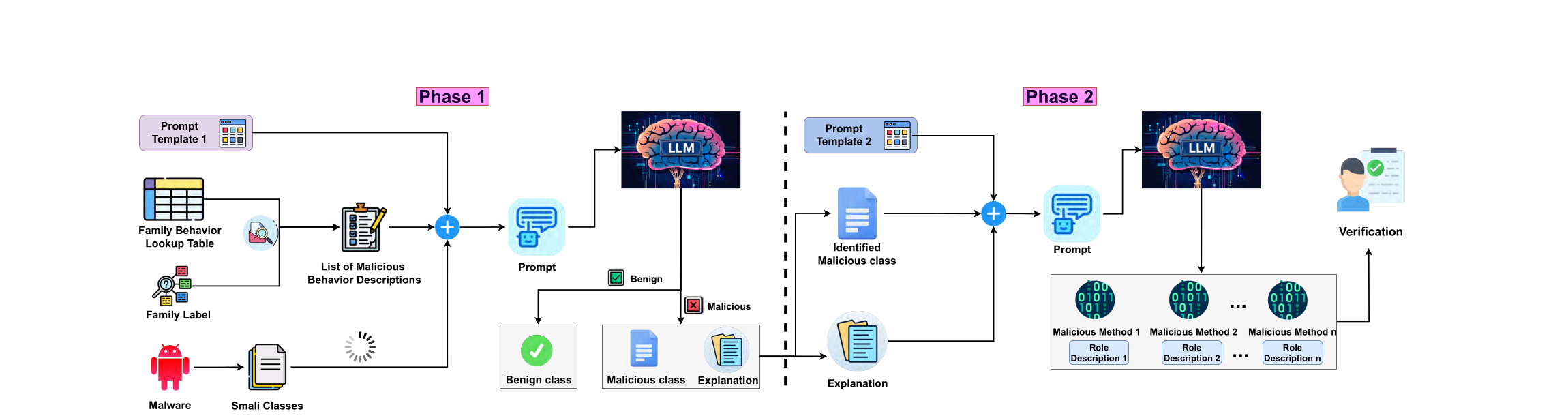
Fine-grained localization of malicious payloads in Android malware using LLMs. MalLoc works in two phases: Phase 1 identifies which Smali class implements a given malicious behavior, then Phase 2 pinpoints the exact methods inside it and gives each a plain-language role — going beyond coarse malware detection and family classification to actionable, method-level explanations.
How it works
Interactive demo
MalLoc localizes malicious payloads in Android malware at method level, in two LLM phases. Phase 1 identifies which Smali class implements a given malicious behavior; Phase 2 pinpoints the exact methods inside it and gives each a plain-language role. Start with the shortened RuMMs paper example, then explore three clearly marked fictional localizations that show how the same interface could behave for other payload types.
Pick a task above to see it in action.
No model runs in the browser. “Privacy Stealing” is a shortened rendering of the RuMMs case documented by the paper and deliberately has no invented confidence score. Every scenario prefixed “Mock” uses fictional packages, methods, confidence values, and explanations; those are interface simulations, not MalLoc results.
Paper
Cite this artifact
@inproceedings{10.1109/ICSME64153.2025.00076,
  author    = {Sun, Tiezhu and Alecci, Marco and Pilgun, Aleksandr and Song, Yewei and Tang, Xunzhu and Samhi, Jordan and Bissyand\'{e}, Tegawend\'{e} F. and Klein, Jacques},
  title     = {{MalLoc}: Toward Fine-grained Android Malicious Payload Localization via LLMs},
  booktitle = {2025 IEEE International Conference on Software Maintenance and Evolution (ICSME)},
  year      = {2025},
  pages     = {761--766},
  publisher = {IEEE},
  doi       = {10.1109/ICSME64153.2025.00076},
  url       = {https://doi.org/10.1109/ICSME64153.2025.00076}
}