
Patcherizer
Learns a task-agnostic representation of code changes by fusing the surrounding context with two intention-aware encoders — a Transformer over the token sequence and a GCN over the AST before/after the change. The learned embedding powers three downstream tasks: code-change description (commit-message) generation, patch correctness assessment, and change-intention detection. Trained on a dataset of 90k parsable code changes.
How it works
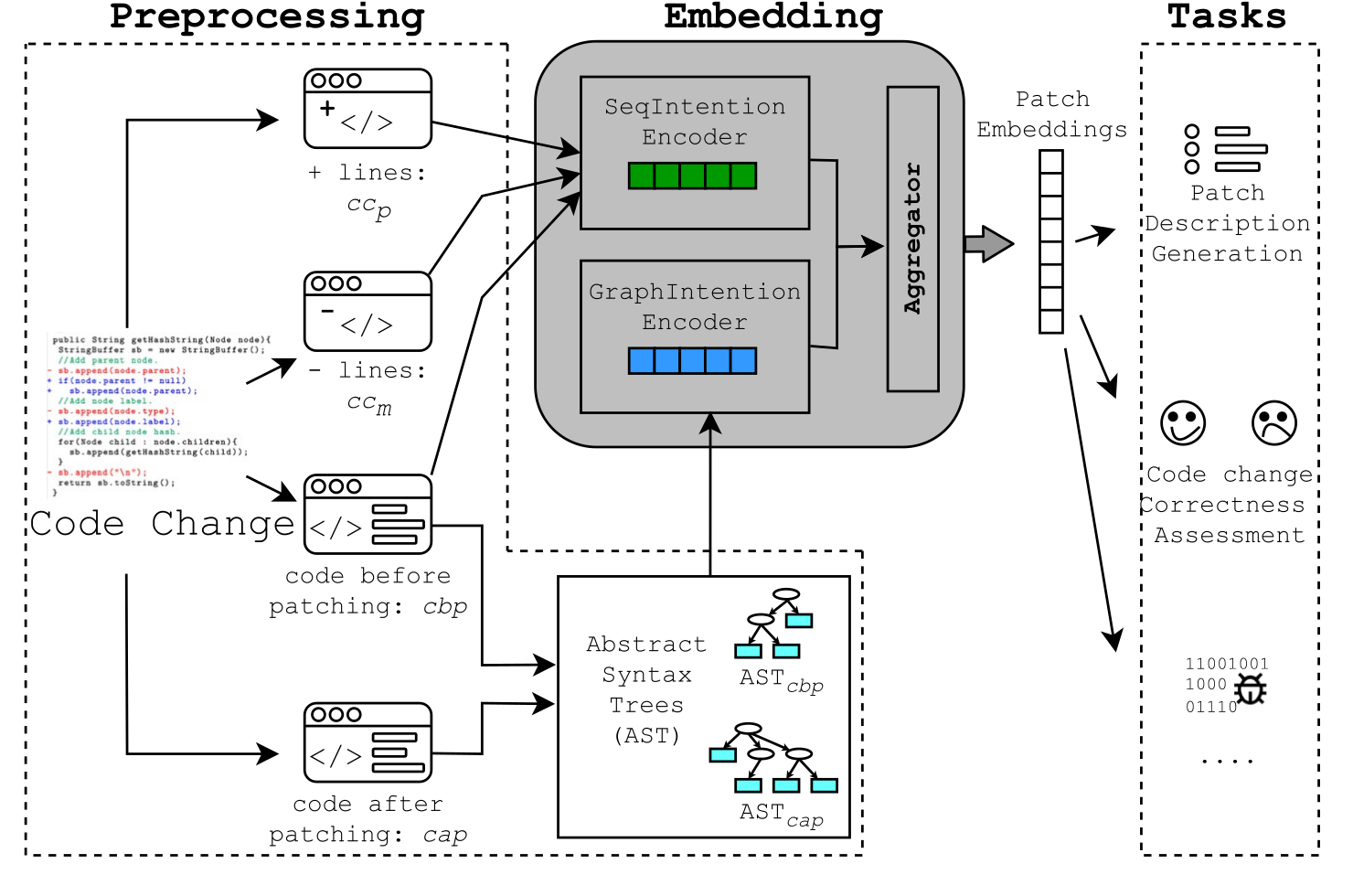
Interactive demo
Pick a code change to preview a simulated pass through Patcherizer's shared representation and three downstream tasks: change description, patch correctness assessment, and change-intention detection.
Pick a task above to see it in action.
Interactive simulation only — no model runs in the browser. Diffs, generated descriptions, confidence values, correctness labels, and intention labels are fictional examples of the three tasks, not predictions or evaluation results from the paper.
Paper
Cite this artifact
@article{Tang2025patcherizer,
  author  = {Tang, Xunzhu and Tian, Haoye and Pian, Weiguo and Ezzini, Saad and Kabor\'{e}, Abdoul Kader and Habib, Andrew and Kim, Kisub and Klein, Jacques and Bissyand\'{e}, Tegawend\'{e} F.},
  title   = {Learning to Represent Code Changes},
  journal = {Empirical Software Engineering},
  year    = {2025},
  volume  = {31},
  number  = {3},
  pages   = {50},
  publisher = {Springer},
  doi     = {10.1007/s10664-025-10763-6},
  url     = {https://doi.org/10.1007/s10664-025-10763-6}
}