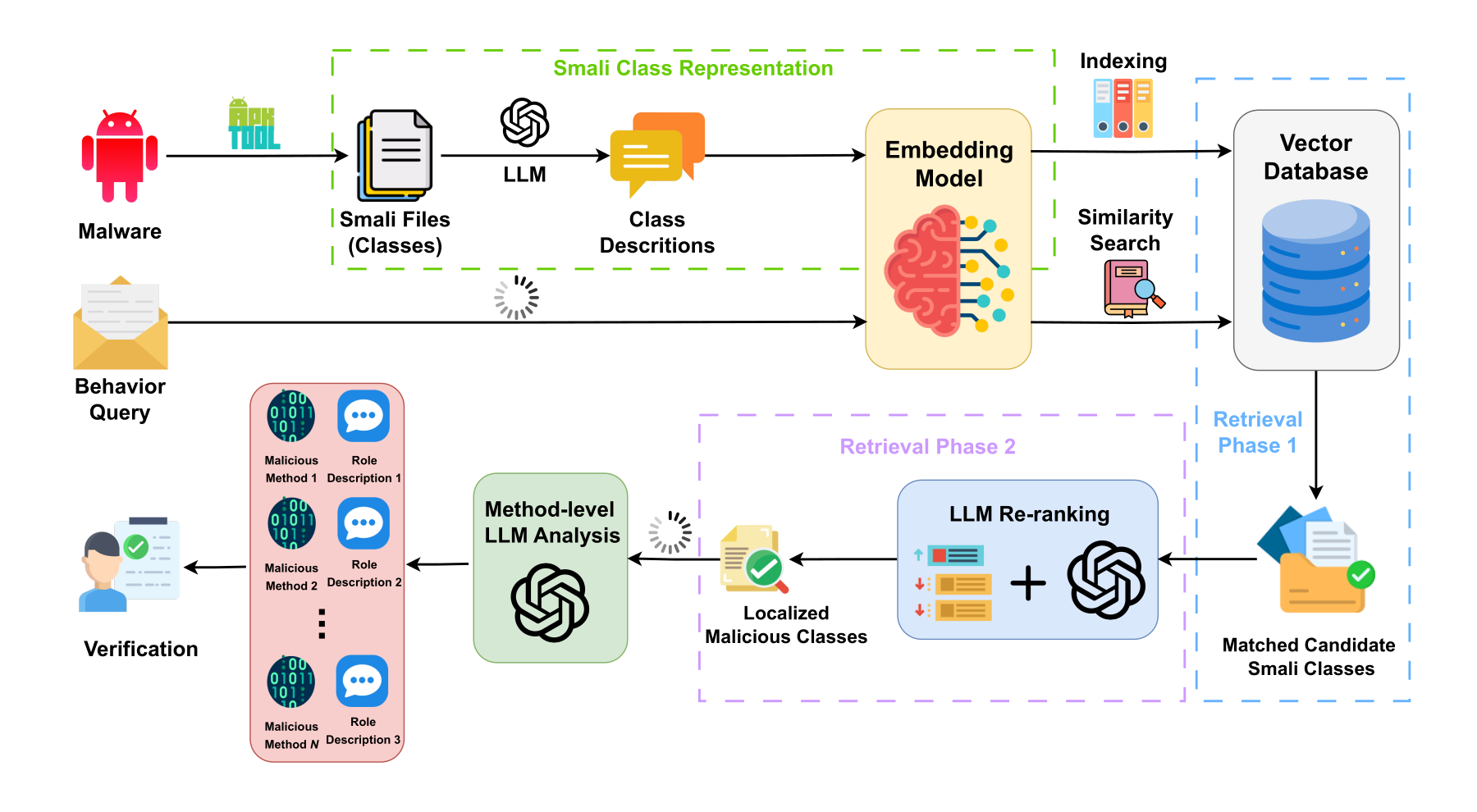
Retrieval-augmented localization of malicious payloads in Android apps — combines LLM-generated class descriptions, vector search, and LLM re-ranking to pinpoint malicious classes and methods from a behavior query.
The overview of the RAML pipeline (ASE 2025 paper, Figure 2)
Interactive demo
Pick a behavior. RAML describes Smali classes, retrieves and re-ranks the candidates most related to the behavior, then pinpoints the methods involved and explains each one's role.
Pick a task above to see it in action.
Simulated preview using representative fictional Smali inputs, class names, roles and similarity scores; no model or API is called in the browser. The pipeline and behavior categories follow the artifact, but these localized methods are illustrative and are not paper results.
@inproceedings{10.1109/ASE63991.2025.00351,
  author    = {Sun, Tiezhu and Alecci, Marco and Song, Yewei and Tang, Xunzhu and Kim, Kisub and Samhi, Jordan and Bissyand\'{e}, Tegawend\'{e} F. and Klein, Jacques},
  title     = {RAML: Toward Retrieval-Augmented Localization of Malicious Payloads in Android Apps},
  booktitle = {2025 40th IEEE/ACM International Conference on Automated Software Engineering (ASE)},
  year      = {2025},
  pages     = {3963--3967},
  publisher = {IEEE},
  doi       = {10.1109/ASE63991.2025.00351},
  url       = {https://doi.org/10.1109/ASE63991.2025.00351}
}